ServicesConcrete Courtyards
Concrete Courtyards in Tustin
A courtyard is concrete with walls around it, so every drop of rain has to leave by a route we plan. We set the slope, place the drains, keep the slab below your door thresholds and finish the surface to suit your home.
A slab with nowhere for water to run
An open patio can shed water onto the lawn. A courtyard usually can't. With your home on one or more sides and walls or a gate closing the rest, the slab has to carry water to drains or to a planned outlet, and it has to do that without pushing water toward the foundation or under a door.
That is why we treat a courtyard as a drainage job first and a finish second. We work out where the low points go, how the pipe leaves the space and how the new surface meets each doorway before anything is formed. Then we choose the finish: a fine broom, a smooth sand finish, exposed aggregate, integral color or stamped concrete.
If your courtyard opens onto a larger yard, our patios or concrete backyards pages may describe your project more closely.
What a courtyard project includes
Demolition and haul-off
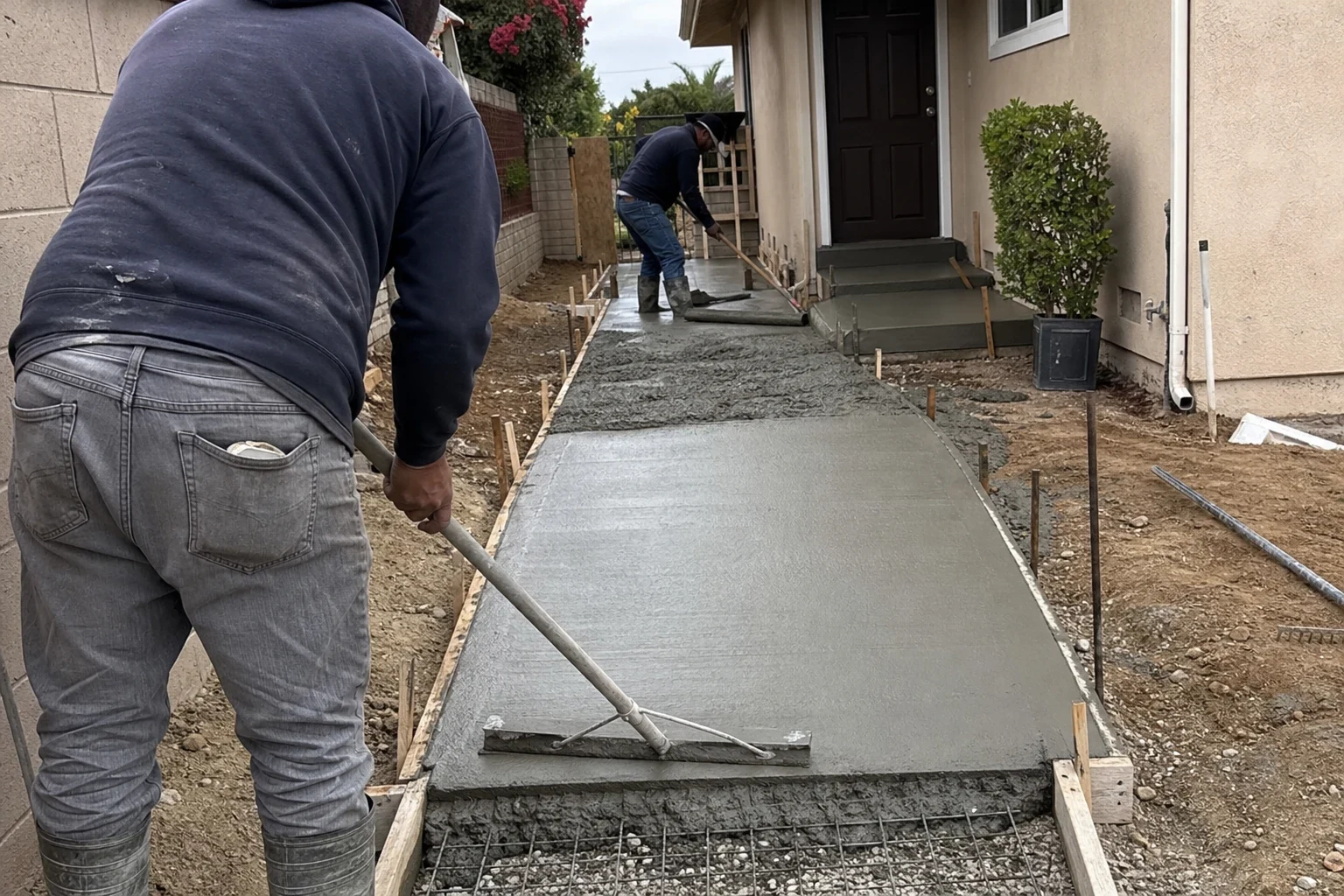
We break out old concrete, pavers or tired landscaping and haul it away. In a closed courtyard this often goes out by wheelbarrow through a side gate, and we protect the path we use.
Grading and compacted base
We excavate to depth, compact the subgrade and place a compacted gravel base. Clay soil is common around Orange County, and a firm, even base keeps it from moving the slab as it swells and dries.
Drains and slope
We set area drains or a trench drain at the low points and pitch the slab toward them, with grade running away from the house. Drain lines are routed out of the courtyard to an approved discharge point.
Reinforcement and joints
Rebar on chairs holds the slab together, and control joints are laid out so they line up with corners, columns and doorways instead of cutting across them at odd angles.
Finish and color
We pour, finish and cure the surface you chose, then clean up the edges where concrete meets stucco, planters and steps.
Signs your courtyard needs new concrete
Water stands after rain
Puddles that sit for a day, or a sheet of water against the wall, mean the surface has no working fall to a drain.
Water reaches the door
If rain creeps toward a slider or soaks the threshold, the slab may be too high or sloped the wrong way. That needs correcting at the grade, not with a bead of caulk.
Pavers sinking or heaving
Uneven pavers trip people and collect water in the dips. Replacing them with a reinforced slab gives you one flat, drained surface.
Dirt or gravel that never stays put
Bare ground tracks into the house and turns to mud in winter. A slab makes the space usable all year.
Drains that clog or sit too high
An area drain set above the surrounding concrete can't collect anything. New concrete lets us place drains where they actually do their job.
How a courtyard job runs
- 1
Walk-through and measurements
We look at the doorways, wall footings, existing drains and how we will get material in. We measure the fall available from the house to each possible drain location.
- 2
Written scope and city check
You get a written estimate that lists demolition, drainage, base, reinforcement and finish as separate lines. We check with the City of Tustin whether your work needs a permit, explain what the answer means and pull it when one is required.
- 3
Forming and drain layout
We set forms, drains and pipe, then confirm slope with a level before the pour. If an inspection applies, it happens at this stage, before concrete covers anything.
- 4
Pour and finish
Concrete arrives by line pump when the truck can't get close, which keeps it off your floors and landscaping. We place, finish and cut joints the same day.
- 5
Curing and cleanup
We cure the slab, strip forms, clean the walls and leave you clear guidance on when to walk on it and when furniture can go back.
What sets the price of a courtyard
Courtyard pricing depends less on square footage than you might expect. Access and drainage often matter more. We price each item separately so you can see where the cost comes from.
- Getting material in
- A courtyard reached only through a narrow gate or the house usually needs a line pump and hand demolition. Easy truck access costs less.
- Drainage work
- The number of drains, the length of pipe and how far it has to travel to an outlet all affect labor and materials.
- What comes out first
- Removing an old slab or bedded pavers takes more time than clearing dirt, and haul-off is priced by volume.
- Finish choice
- A broom finish is the simplest. Integral color, exposed aggregate and stamped patterns each add material and finishing time.
- Thresholds and city fees
- If a permit applies, its fees and inspection visits are part of the estimate. Tight clearances at doorways may call for extra excavation to keep the slab low enough.
Courtyard questions we hear
Something not covered here? (714) 582-1691
Does a concrete courtyard need a permit?
Many flatwork projects on private property don't, but it depends on the scope. Changes to drainage, work near a structure or added steps can trigger one. We confirm with the city before we start and tell you plainly what applies. If one is needed, we pull it and schedule the inspection.
How do you pour concrete into a courtyard with no truck access?
We use a line pump. The truck stays at the street and concrete travels through a hose laid along a protected path, so nothing is carted across your floors or lawn.
Where does the water go?
It drains to area drains or a trench drain set at the low points, then through pipe to an approved discharge point. The slab is sloped so water moves away from the house and toward those drains, never toward a door.
Will the slab crack?
Concrete shrinks as it cures, and some hairline cracking is normal. We place control joints so movement happens along clean lines, and the compacted base and rebar keep the slab from shifting.
When can we use the courtyard again?
Light foot traffic is usually fine after a day or two. We suggest waiting about a week before bringing back heavy planters or furniture, and we will tell you if weather changes that.
Start with the drainage plan
Tell us about the doors, walls and access around your courtyard. We will explain the slope, the drains and what the city requires before you decide anything.